The Nativity of the Theotokos Convent in Grodno: a living monastery two minutes from Gosteam
From Gosteam at 31 Mostovaya Street to the Holy Nativity of the Theotokos Convent it is about 200 metres. Why go in, and how to continue the walk through the centre from there.
Holy Nativity of the Theotokos Convent in Grodno. 3 Davida Gorodenskogo Street — about 200 metres from Gosteam
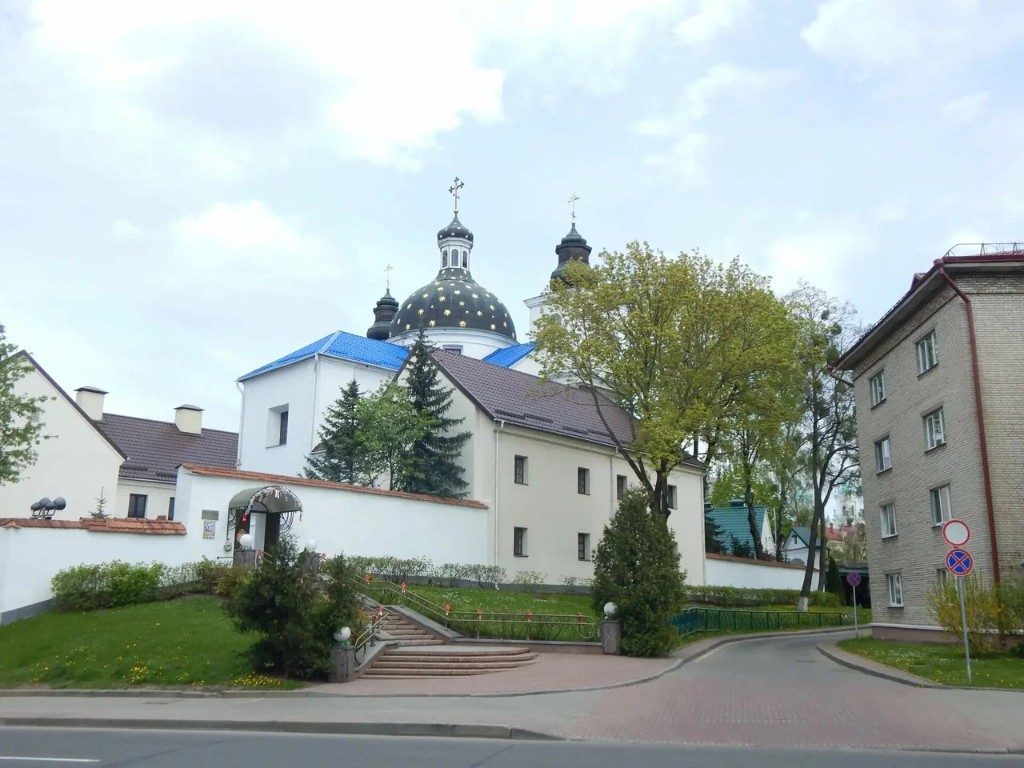
Domes with gold stars are already visible from Mostovaya, and the stair to the gate starts at the pavement. Two minutes from 31 Mostovaya Street stands the Holy Nativity of the Theotokos Metropolitan Convent — a working convent in the historic centre, white walls behind the gate.
That is what Gosteam’s address actually means. You do not “plan the monastery for the afternoon”. You walk out of the hostel — and you are already looking at the gates.
A neighbour on the street, not a pin on the outskirts
The hostel is on Mostovaya. The convent is at 3 Davida Gorodenskogo Street. As the crow flies that is under two hundred metres; on foot along the streets it is about 200–250 metres, two or three minutes.
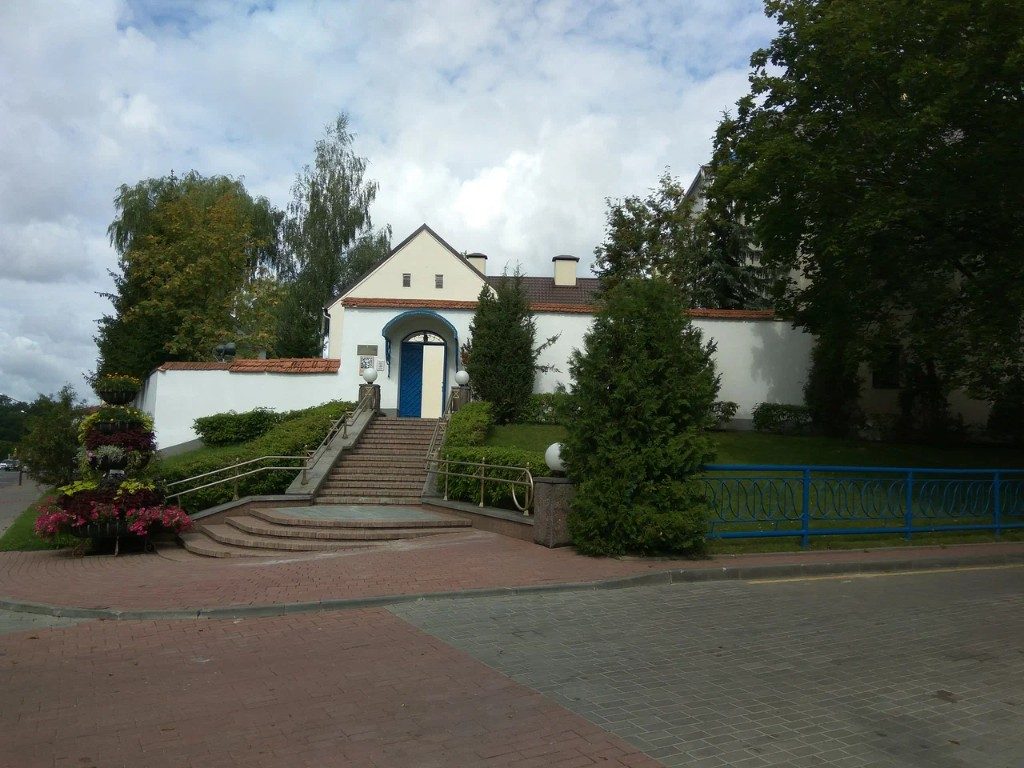
The domes show up on an ordinary walk around the house — and from the windows of some rooms at Gosteam: the convent is part of the view from the room, not only a stop on the day’s route. The stair to the entrance starts right from the pavement: no hunting for a courtyard gate, no need for a taxi.
The entrance from Davida Gorodenskogo Street — the threshold that is two or three minutes from Gosteam.
For a guest that changes the day. In the morning you can go to liturgy and be back for breakfast. In the afternoon you can show the convent to children without “going into town”. In the evening you pass the lit walls on the way to the castles.
Older than the guidebooks
The monastery stands on the site of the 12th-century Prechistenskaya Cathedral — a contemporary of Kalozha Church. What you see today is several lives of the city stacked together.
The stone Church of the Nativity of the Theotokos was built in 1720–1751 to a design by the Italian architect Giuseppe Fontana III: late Baroque, a recognisable silhouette, blue roofs and a starry dome. From 1843 it has been an Orthodox convent. In 1866 a warm church of St Sergius of Radonezh was added to the complex.
In 1960 the convent was closed. The church later housed a museum of atheism; a piano stood in the sanctuary. On 10 May 1992 the monastery was returned to the Church; the first service was held on 1 July. Since 2002 it has been a metropolitan convent, directly under the Patriarchal Exarch.
For a visitor this is not an encyclopaedia note. It is a rare case where a thousand years of the city and a living prayer sit on the same street as your room.
The main shrine is the miracle-working icon of the Mother of God “Our Lady of Vladimir, Myrrh-Streaming”. Even if you only stop briefly, the ensemble from the street is already worth the pause.
How to go in without fuss
This is a working convent, not a viewing platform. Dress modestly: shoulders and knees covered; women usually cover their hair. Do not take photos inside unless you have asked. Speak quietly.
Services are usually daily except Monday (unless it is a feast). Liturgy on weekdays is around 8:00, on Sundays and feasts around 9:00. Evening service is more often at 18:00 in summer and 17:00 in winter. Check the exact timetable on obitel-grodno.by or on the spot.
If you are not ready to go into the church, that is enough: the façade, the stair and the domes read from the street. The architecture is not hidden behind a ticket desk.
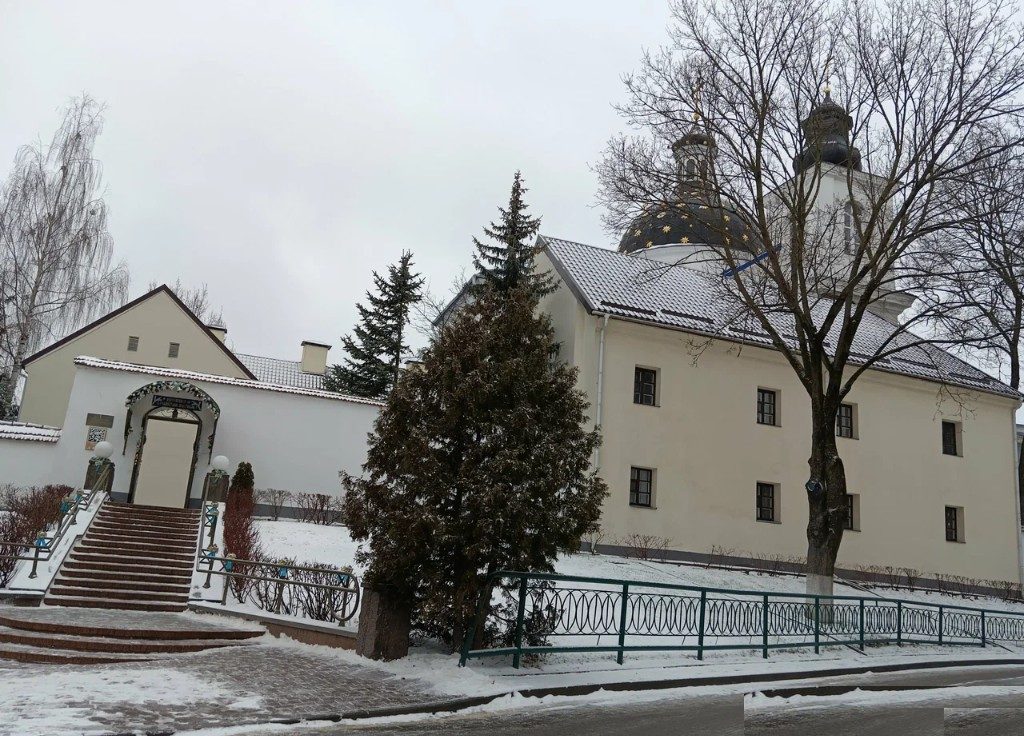
In winter the same walk: leave Gosteam — and a few minutes later you are at the stair. The convent is not a “seasonal sight”.
What to see next — without going “back into town”
After the convent you do not need a taxi. You are already in the Grodno you came for.
A short loop:
Gosteam → Nativity of the Theotokos Convent → New Castle → Old Castle
From the convent the castles are even closer than from the hostel. On the same walk you can turn toward the drama theatre at 35 Mostovaya Street — another century and another face of the city, also a few minutes away. The other way, still on foot, is the Church of the Finding of the Holy Cross: the Bernardine church on the high bank of the Neman.
That is how the centre works if you live in it instead of commuting in for a tour: the 12th century underfoot, 18th-century Baroque overhead, the royal castles around the corner, the Soviet modernism of the theatre — no transfers.
Why this works from Gosteam
Grodno has plenty of rooms “not far from the centre”. The rare thing is to wake up so that the convent’s domes are in the window in the morning, and the castles and the theatre are a walking habit, not a pin in a maps app.
House 31 on Mostovaya is the former Shereshevsky tobacco factory. In 1900 the convent was even moved to Krasnystok, in part because the streets were tight and the tobacco factories stood next door. Guests now stay in one of those historic houses — and the convent is next door again, revived and open.
You can leave the car on the closed car park and not touch it until you leave town. Families do not have to choose between “making the service” and “not waking the children in a taxi”. Groups do not lose an hour on a transfer. Anyone travelling alone steps into the street and immediately sees why Grodno is a walking city.
About 200 metres. Two or three minutes. That is not a slogan. It is the route from reception to the stair.
To see which pages people open, the site can turn on Yandex Metrica and Google Analytics. They set cookies. We do not start the counters without your consent. Personal data policy