The Church of the Finding of the Holy Cross in Grodno: a Bernardine church four minutes from Gosteam
From Gosteam at 31 Mostovaya Street to the Church of the Finding of the Holy Cross it is about 250 metres. Why go in, and how to continue the walk through the centre from there.
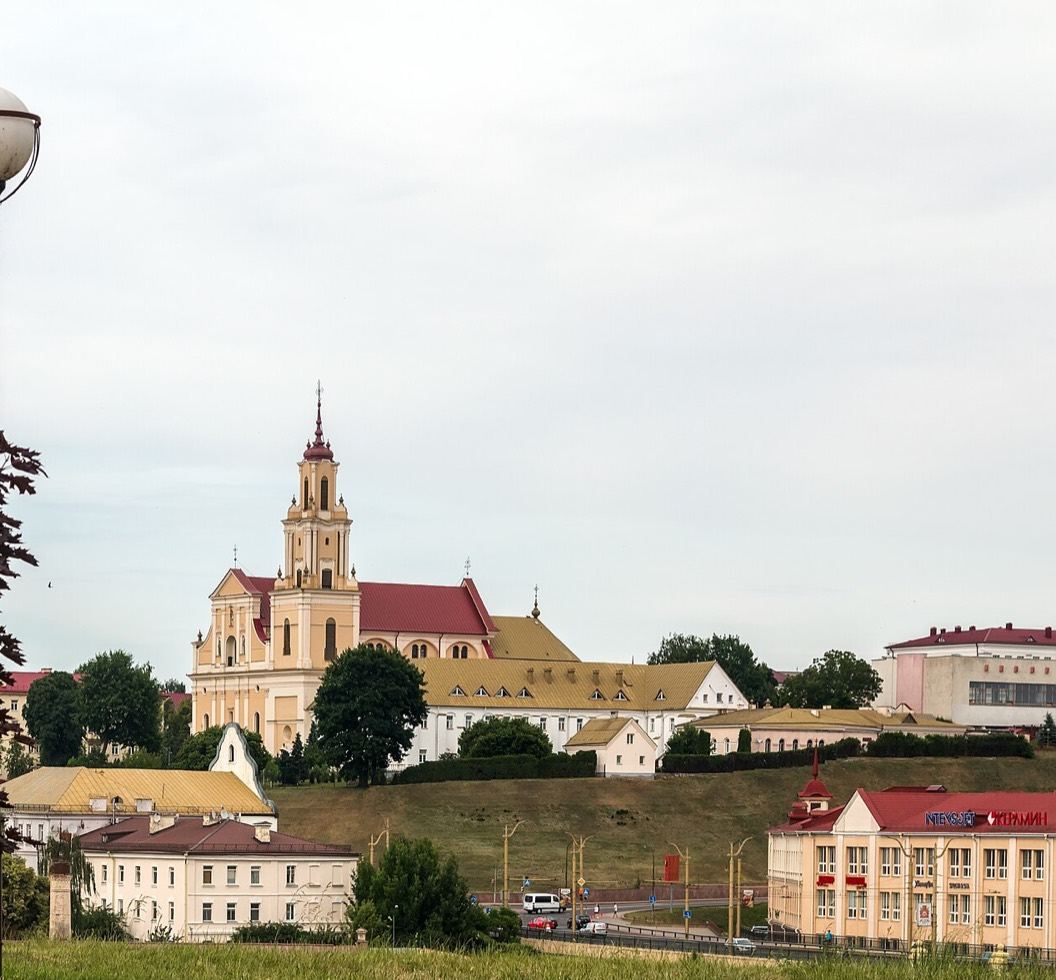
Church of the Finding of the Holy Cross on the high bank of the Neman. 1 Parizhskoy Kommuny Street — about 250 metres from Gosteam. Photo: Mike1979 Russia, CC BY-SA 3.0, Wikimedia Commons
From the high bank of the Neman the white tower is visible before any street sign. Closer to the river stands the Church of the Finding of the Holy Cross. The Bernardine church has a history of its own: Gothic still holds in the sanctuary, the façade already mixes Renaissance and Baroque, and the bell tower belongs to Vilnius Baroque. People come here for Mass. The camera is secondary.
From Gosteam at 31 Mostovaya Street to 1 Parizhskoy Kommuny Street it is about 250 metres. On foot that is three or four minutes.
A neighbour on the Neman
The Farny Church stands on Sovetskaya Square. The Bernardine church rises above the river. Both belong to the historic centre, yet they occupy different hills and carry different fates. A card that simply says “a church in Grodno” makes them easy to confuse: from the street both are white, both have towers, both look like “the main one”.
For a guest the difference is immediate. You need not save the church for the afternoon or hunt for a taxi. You leave the hostel, walk up toward the bank, and the tower is already in view.
Older than the guidebooks
A wooden Bernardine monastery was founded in 1494 on land given to the order by Alexander Jagiellon. The stone church was begun under Sigismund III Vasa. The cornerstone of the altar was laid in 1602; the consecration took place on 13 May 1618.
In 1656 a fire badly damaged the church and the monastery. The complex was rebuilt slowly: chapels were added, altars were changed, a new silhouette was sought. The four-tier bell tower, set between the church and the residential wings, appeared in the eighteenth century. It is Vilnius Baroque, with a figured crown, a spire and a separate entrance. The tower can be read from a distance and holds the whole ensemble together.
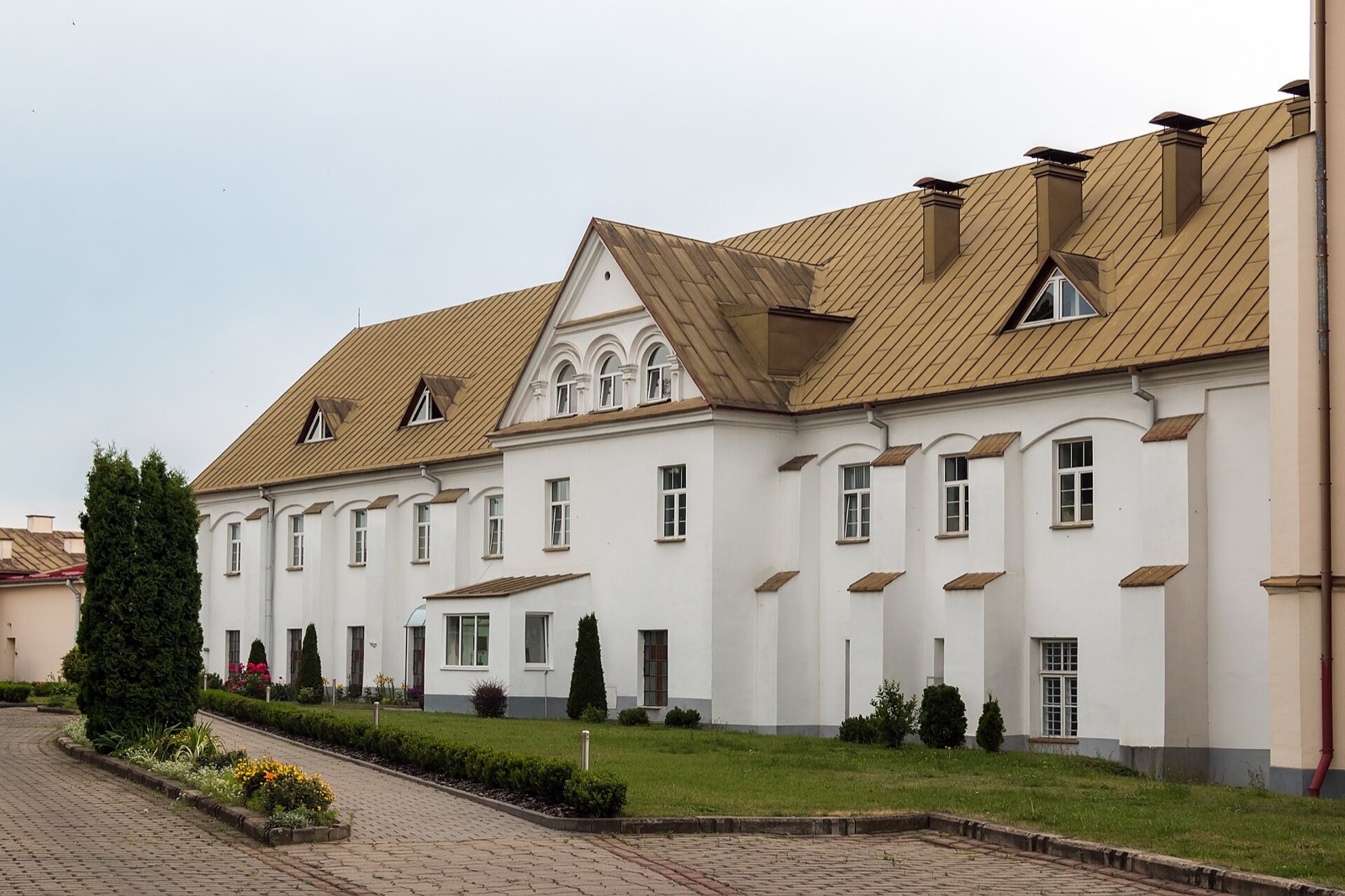
In 1863 the monastery was suppressed and the church became a parish church. In the Soviet years the wings housed offices that had no use for prayer. Since 1990 a Roman Catholic seminary has worked here. The courtyard belongs once more to study and to the liturgy.
On 21 January 1858Eliza Orzeszkowa was married in this church. For a guest that is more than a footnote in an encyclopaedia. The city went on living inside these walls while governments and shop signs changed on the streets nearby.
What to look at, even if you stay outside
From the Neman the ensemble comes together at once: the tower, the red roof, the white monastery wings on the rise. It is one of the landmarks of the centre. You do not need a ticket to understand its scale.
The sanctuary is older than the rest of the building. A semicircular apse, buttresses and pointed windows give away the Gothic. The main façade is already early Baroque: pilasters, niches, a gently curved crown. If you go inside you will see carving, stucco, frescoes and the Loreto chapel. From the street the façade and the tower are enough. They stop you on their own.
The former monastery wings. A seminary has been here since 1990, and the courtyard keeps an ordinary working day. Photo: Mike1979 Russia, CC BY-SA 3.0, Wikimedia Commons.
How to go in without getting in the way
The church is in use. Dress modestly, keep your voice down, and do not take photographs during Mass. Services are often in Polish: the parish still prays in the language that has been spoken here for centuries.
There is no need to wander the cloister out of curiosity. A seminary lives there, and it is someone else’s house. The architecture of the church and the tower reads clearly from the street and from the slope down to the Neman.
Check the Mass times on the Grodno diocese site grodnensis.by or when you arrive.
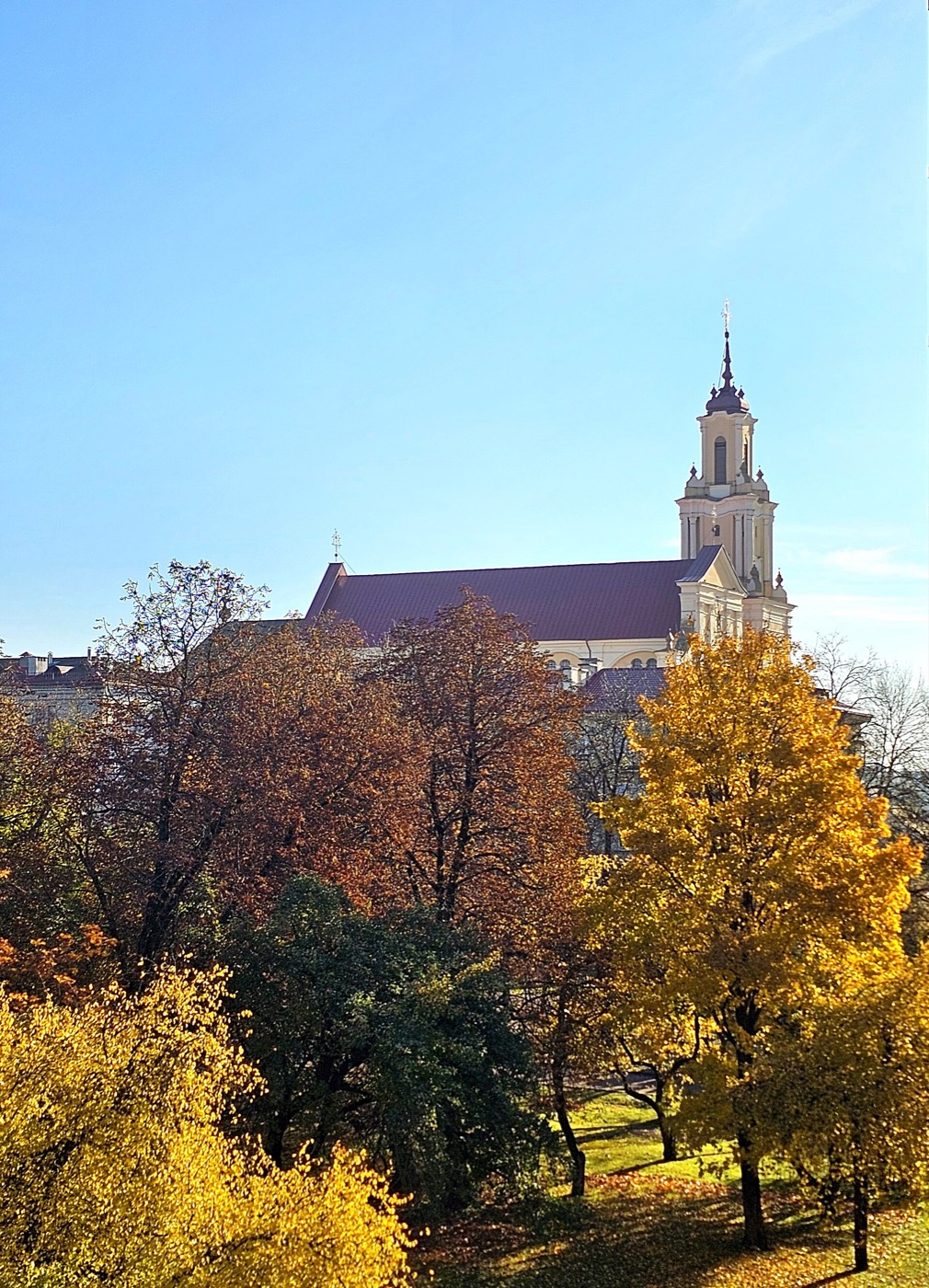
The same walk in another season. You leave Gosteam, walk a few minutes, and the tower already fills the frame. Photo: Dina Panayotis, CC BY-SA 4.0, Wikimedia Commons.
What to see next
After the Bernardine church you will not need a taxi. You are already inside the Grodno you came for.
The theatre stands on the same Mostovaya Street. The convent is two or three minutes the other way. If you want the Farny Church and the pharmacy-museum, walk on to Sovetskaya. That is another five or six minutes, still on foot.
This is how the centre works when you sleep in it. Gothic and Baroque above the Neman, the Soviet modernism of the theatre, the convent’s domes and the Farny Church around the corner fold into a single loop. No transfers required.
Why this is easy from Gosteam
Grodno has plenty of rooms next to the centre. What is rarer is to wake up and find that the Bernardine church, the theatre and the convent are an ordinary walk, one for which you do not even open a map.
You can leave the car on the closed car park and not touch it until you leave town. A family does not have to decide whether to make Mass or take the children across the whole city. Anyone travelling alone steps into the street and immediately understands why Grodno is a city to be seen on foot.
From reception to the tower above the Neman it is about 250 metres. Three or four minutes. The shortest route of the morning.
To see which pages people open, the site can turn on Yandex Metrica and Google Analytics. They set cookies. We do not start the counters without your consent. Personal data policy